
The first question wasn't 'Can we get a discount?' It was 'Are we ordering the right things?' A supplier can offer a perfectly reasonable price for a package that's bigger than the job requires.
For this event, Pearl Lemon Catering & Events, another business in Pearl Lemon Group, worked through the initial quote line by line. The revised order came in 23.7% lower. We checked the supplier correspondence, final invoice and payment record to confirm the comparison.
Why the first quote needed a rethink
The supplier's original menu was broader than the organiser wanted. Guests needed halal chicken and a substantial vegetarian choice, with no red meat, pork, fish or seafood. The team also spotted sides and tablecloths that didn't need to be part of the order.
But the event still needed to run smoothly. Staff, reusable plates and cutlery, buffet equipment, delivery, setup and collection all had to stay. Saving money on the food while forgetting the service would simply have moved the problem elsewhere.
What the team changed
Unnecessary scope
The team removed lamb, replaced it with paneer and cut the extra sides and tablecloths the organiser didn't need.
Essential delivery
The order still covered halal chicken, a substantial vegetarian option, serving staff, reusable tableware, equipment, delivery and collection.
With the order clearly set out, the team agreed the revised purchase with the supplier and checked the final invoice. The cost came down because the order changed, while the services required to run the event stayed in place.
The numbers, without the confidential prices
The comparison uses the same ex-VAT basis for the opening quote and final invoice. These are different specifications; the percentage measures spend reduction, not like-for-like unit-price savings or return on investment.
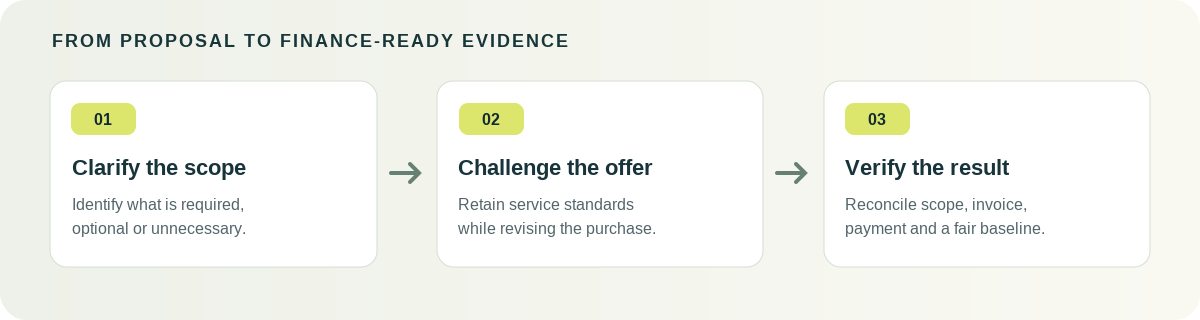
Why this was more than a revised quote
The supplier sent a final invoice for the revised order, and its account statement recorded the payment. That matters: it tells us what the group business actually purchased and paid, rather than what someone hoped to negotiate.
The team achieved a lower bill without dropping the essentials. They weren't paying for extras they didn't want, and they hadn't accidentally lost the staff or equipment needed on the day.
This is a useful example of better buying, rather than a claim about an external consultancy project or a repeatable return. You can apply the same discipline to larger contracts: agree the service first, then compare the complete cost.
What a bigger buying team can take from this
Freight, facilities and software contracts all pose the same question. Did the carrier remove a surcharge? Did the cleaner reduce the hours? Did the software vendor lower its price or simply remove unused seats? Each could be a sensible change, but you need to know what drove the reduction.
Start with three questions: What did the original offer include? What does your business need? What did you finally agree to buy? Once those answers are clear, finance can check the commercial effect.
For your next renewal, use our supplier negotiation checklist. Our savings guide explains how to compare changes on a fair basis.